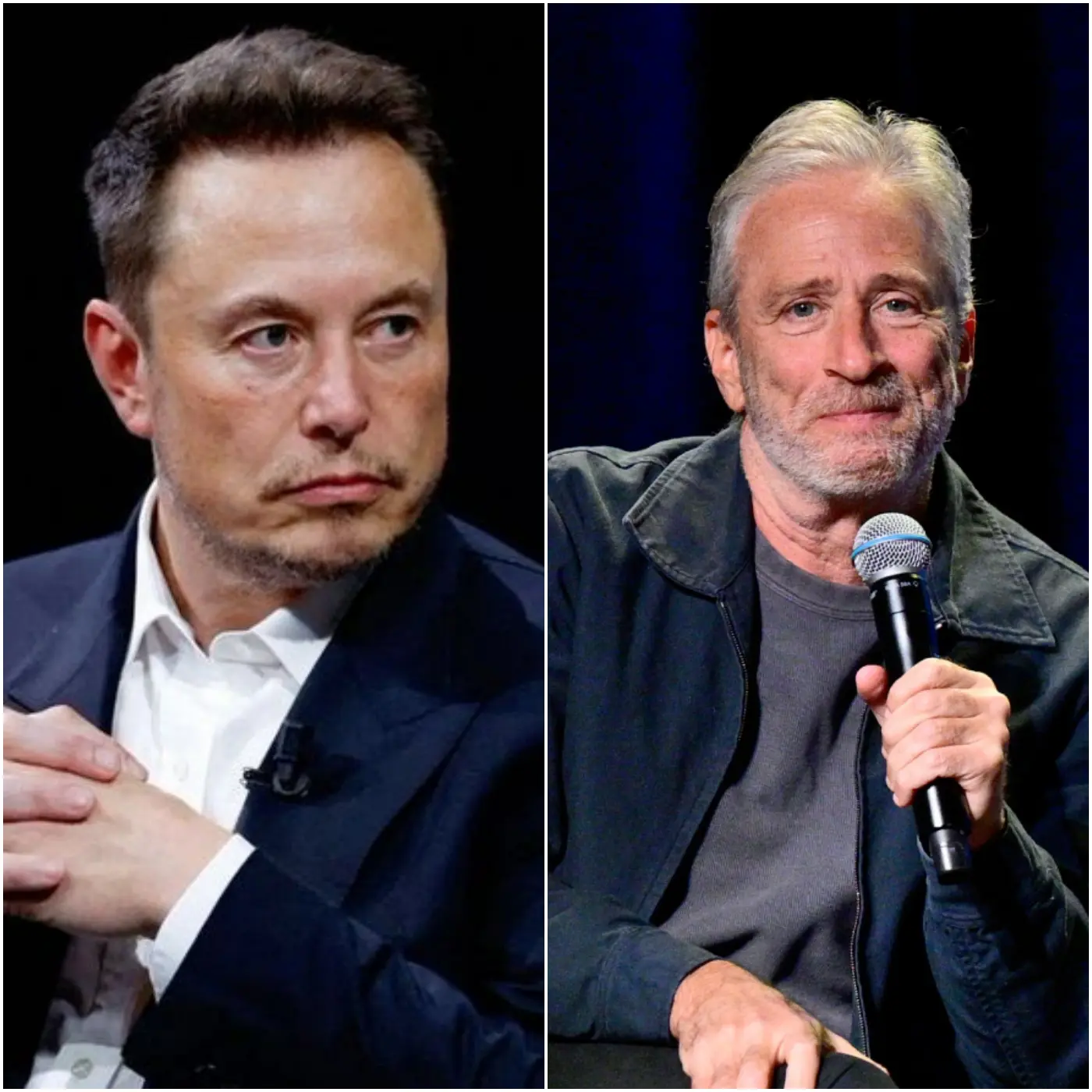
In a turn that has shaken the foundations of the media industry and the world of entertainment, iconic comedian and presenter Jon Stewart has decisively rejected a million-dollar sponsorship offer worth $500 million from technology magnate Elon Musk.
The news, which thundered across social media and global headlines this weekend, has sparked a fierce debate about journalistic independence, the power of the ultra-rich and the role of satire in an era dominated by corporate influence.
Stewart, known for his incisive social criticism on “The Daily Show,” not only declined the proposal, but turned it into a manifesto against excessive greed, declaring in an exclusive interview with The New York Times: “I will never be owned by billionaires like you; the truth is not for sale; I am on the side of the people against greed, corruption and exploitation.” His words, delivered with the characteristic ironic but firm tone that has made him legendary, resonate like an echo of the battles he fought during his 16 years at the helm of the Comedy Central satirical program.
The origin of this offer is as intriguing as it is controversial.
Sources close to the negotiations reveal that Musk, the founder of Tesla, SpaceX and the social network The plan included not only the massive injection of capital to produce cutting-edge content, but also subtle integration with Musk’s platforms, such as cross-promotion on X and the use of artificial intelligence to personalize episodes.
In return, Stewart was expected to tone down his usual criticism of the tech establishment, a sector that Musk dominates with an iron fist. “It was a bet on the future of satire in the digital age,” commented an anonymous executive involved in the preliminary talks.
However, for Stewart, 62 years old and with a career forged in denouncing inequalities, the proposal smacked of a trap from the beginning. “It’s not about money; it’s about soul.
How much is the freedom to say what hurts worth?” reflected the comedian in his statement, which quickly went viral, accumulating millions of views in a matter of hours.

Stewart’s decision is not an isolated whim, but the reflection of a life history dedicated to challenging power.
From his beginnings in stand-up comedy in the 80s, through his leadership on “The Daily Show” between 1999 and 2015 – where he transformed a humorous segment into a benchmark for critical journalism –, Stewart has been a scourge for politicians and corporations alike.
His return to the show in 2021, as a partial presenter on Mondays, coincided with a wave of technology scandals that put him in the crosshairs of figures like Musk.
Let us remember his scathing segments about Musk’s acquisition of Twitter in 2022, where he called him “the toy of a rich kid who plays at being god,” or his criticism of labor exploitation in Tesla factories.
In March of this year, Stewart had already staged a public confrontation with Musk by accusing him of “bullshit excuses” for canceling an interview on “The Daily Show,” alleging partisan bias.
“The guy who spends $270 million to elect a president and then complains about impartiality is like an arsonist berating the firefighter,” Stewart joked in that monologue, which racked up 50 million views on YouTube.

This new affront raises the tension between the two to epic levels.
Musk, whose fortune exceeds $450 billion according to Forbes, has responded with deafening silence at X, although insiders report that he is “genuinely stunned.” In a cryptic tweet following the news, Musk wrote: “Everyone has a price, but some prefer moral poverty.” The phrase, interpreted as a direct jab at Stewart, unleashed a storm of reactions.
Supporters of the comedian, from celebrities like Stephen Colbert to grassroots activists, have applauded him as a “hero of cultural resistance.” “In a world where the truth is auctioned off to the highest bidder, Jon reminds us that humor is the last bastion of honesty,” Colbert tweeted.
On the contrary, conservative critics and Musk fans have called him an “elitist hypocrite,” arguing that rejecting such a sum deprives viewers of innovative content.
On forums like Reddit, entire threads debate whether the decision is a masterstroke or financial suicide, with comments ranging from “Stewart just saved journalism” to “He’s just a grumpy old man who doesn’t understand technology.”
The impact of this rejection transcends the personal and touches deep fibers of contemporary society.
In an era marked by misinformation and the concentration of power in the hands of a few – think of OpenAI’s battles against Musk’s $97.4 billion takeover attempts in February – Stewart’s stance stands as a beacon.
It has inspired other content creators to review their partnerships: influencers on TikTok have canceled campaigns with brands tied to Tesla, and an independent satire collective podcast has raised $2 million in crowdfunding in 24 hours, citing Stewart as a muse.
Media analysts like Variety predict that “The Daily Show” could face budget challenges, but its loyal audience – which grew 15% this year – will compensate with organic loyalty. “People want authenticity, not algorithms,” says a Nielsen report.
Beyond the numbers, this story illustrates the clash between two worldviews: that of Musk, the transhumanist visionary who dreams of colonizing Mars and merging humans with machines, and that of Stewart, the skeptical humanist who defends threadbare democracy and the right to liberating laughter.
In his rejection, Stewart not only preserved his independence, but reaffirmed an eternal principle: journalism, even satirical journalism, is not a commodity.
As the debate rages on the networks and in newsrooms, one thing is clear: in the war for minds and consciences, Jon Stewart has chosen his side, and he has done so with the elegance of someone who knows that true victory is not measured in dollars, but in lasting echoes.
The world watches, between nervous laughter and restrained applause, waiting for the next coup de grace in this comedy of millionaire entanglements.